What is integration? At its simplest, integration is the process of bringing together or incorporating parts into a whole — to combine, mingle, fuse, merge, unite.
Integration is the process of deepening our relationship with our inner and outer worlds — fostering a sense of wholeness. It isn't a single event or a conversation after the fact. It's the ongoing work of taking what opened — in a medicine journey, in grief, in a hard conversation, in a body that finally exhaled — and letting it become part of who you are.
Integration isn't optional. It's a crucial part of the healing journey, and fragmentation — staying split off from the parts of ourselves and each other we haven't yet metabolized — is at the root of most mental and societal dysfunction. Giving ourselves time to integrate is how we move back toward wholeness.
To get a working integration definition you can actually use, it helps to look at it through two different lenses.
Integration as a Brain State
This lens comes from interpersonal neurobiology and developmental psychology. It sees integration as a state of internal coherence, where differentiated parts of the brain and body — sensory, emotional, logical, relational — link together in a flexible, harmonious way. This is the neural foundation of mental health, creativity, and resilience.
An integrated mind can shift between perspectives, stay regulated, and respond rather than react. Integration here is about neural pathways connecting, systems synchronizing, and inner parts collaborating.
Integration as an Evolutionary Process
This second lens widens the view. Integration is a life-long, evolutionary journey of becoming more whole — not only within ourselves, but in relationship with the larger field of life. It's the integrative process of nature itself: diverse elements coming together to create new forms, emergent intelligence, deeper complexity, higher coherence.
In this sense, integration isn't only healing. It's a movement toward greater relational depth, systemic harmony, and conscious participation in the unfolding of life.
Both lenses point to the same underlying truth: integration happens when separate parts — of a brain, a self, a community, an ecosystem — find a way to stay in relationship with each other instead of splitting off. Discernment matters here too. Not every part deserves equal weight forever; some need pruning, some need strengthening, and what emerges from that sorting is often something genuinely new — not just old parts stitched together, but a third thing, made from the relationship between them.
What Is Integration in Everyday Life?
Both lenses are true. Neither is enough on its own, because integration isn't just something that happens to you in a peak experience or a therapy session — it's something you build, in the ordinary hours of an ordinary week.
Seven of the categories below come from Dr. Dan Siegel's Healthy Mind Platter — Siegel is an MD, psychiatrist, and clinician known for his work in interpersonal neurobiology. One category, Hygiene & Cleanliness, has been added here by behaviorist Dr. Victoria Sterkin. Together, these activity types allow a multitude of brain parts to function in harmony with one another, facilitating an integrated state in our neurobiology. The variation itself is key — it's what lets more parts of us come online.
Each week, we should strive to practice each of these categories. Some we'll need daily, like sleep. Some more often than others. Some less. But all are needed.
Sleep
Movement
Hygiene & Cleanliness
Connection & Relational Appreciation
Play: Creativity & Spontaneity
Focus: Goal-Oriented Behavior
Down Time: Intentionally Having No Intention
Time In: Embodiment & Meditation
We all need a mixture of these active and passive activities — the kind that promote connection between upper and lower brain, right and left hemisphere, and specific brain regions across varied octaves of activation. The more parts of the brain that are turned on and in relationship with one another, the more we experience an integrated state of being: a sensation of balance.
When we're integrating a new part of ourselves — learning it, incorporating it into what's already known — variation across these activity types can prime us and enhance that learning. We can also practice playing with the newness itself. Play time, for example, can become a place to visually depict the old, the new, and the third new entity that's emerging between them.
Integration Is Practiced, Not Completed
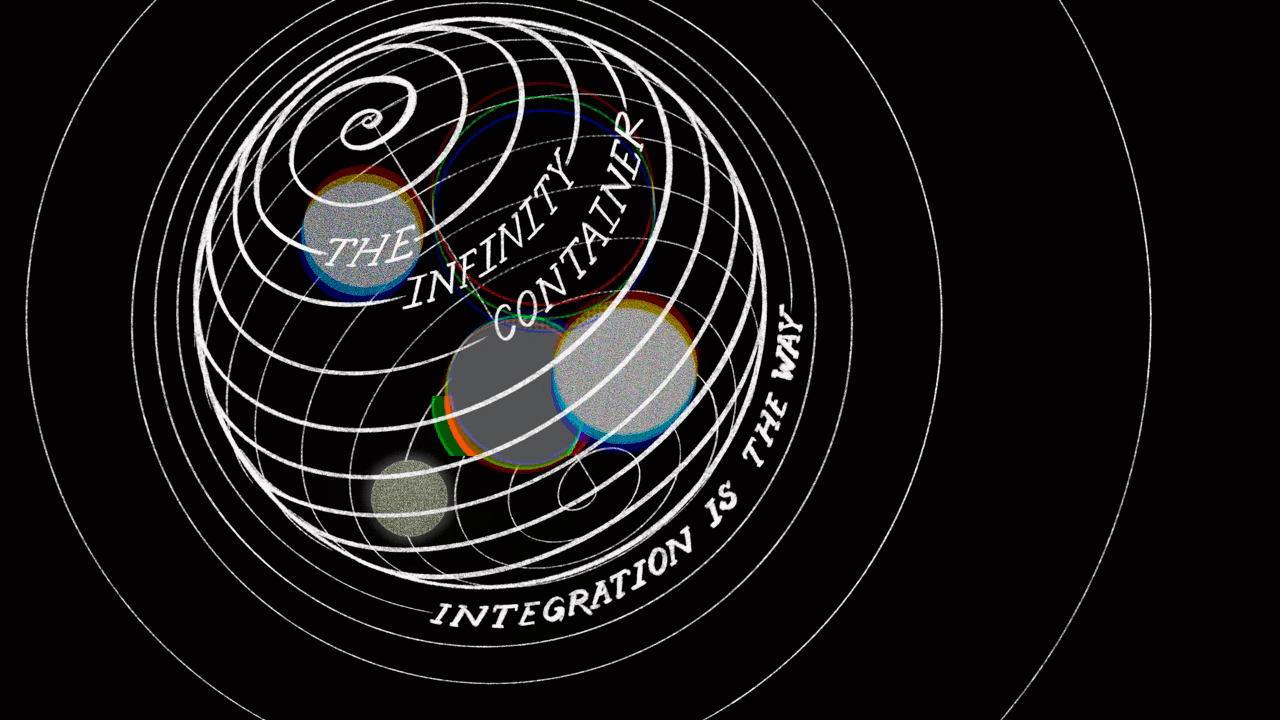
This is why integration inside The Infinity Container isn't organized as a curriculum to finish. It's a practice you return to — a spiral you travel again and again, each time from somewhere new. The Solar-Lunar Framework holds that structure: seven preparation capacities on the Solar Spiral, thirteen integration capacities on the Lunar Spiral, moved through one at a time, in community, month by month.
If you want the fuller story — the science behind why interaction isn't the same as integration, and why this work needs a container rather than a solo practice — read the complete guide on the blog.
Or start simpler: pick one category from the list above that you haven't touched this week, and give it twenty minutes.